Transparency
Classification Methodology
Compliance officers who rely on regulatory monitoring tools need to understand not just what the tool produces, but how. This page documents Ruleward's classification approach in full.
Source Selection Criteria
Ruleward's coverage is defined by explicit inclusion criteria, not a "we cover hundreds of sources" claim. Each regulatory body must meet four criteria to be included in active monitoring:
- Binding relevance: The source issues guidance, rules, or interpretive letters that create compliance obligations for at least one financial services segment we serve.
- Structured publication channel: The agency publishes through a Federal Register notice, official website bulletin system, or structured RSS/API feed that can be monitored reliably.
- Temporal specificity: Publications carry sufficient date and document-type metadata to support accurate classification.
- Materiality threshold: The source has historically produced at least one compliance-material publication per quarter.
Sources that meet criteria but have not yet been implemented are listed as "Roadmap" in our Coverage page. We do not claim coverage we have not built.
Update Cadence by Source
Each monitored source has a defined ingestion interval:
| Source | Ingestion Interval | Publication Types |
|---|---|---|
| Federal Register (OCC/FDIC/Fed/CFPB) | Every 4 hours | Final rules, proposed rules, notices |
| OCC Bulletins / Issuances | Every 6 hours | Bulletins, interpretive letters, FAQs |
| FDIC FIL System | Every 6 hours | Financial Institution Letters |
| Federal Reserve SR Letters | Every 6 hours | Supervisory and Regulatory Letters |
| CFPB Supervisory Guidance | Every 4 hours | Rules, guidance, supervisory highlights |
| SEC Releases | Every 4 hours | Rules, no-action letters, guidance |
| FinCEN Advisories | Daily | Advisories, rulings, guidance |
| NYDFS Circulars / Guidance | Daily | Circular letters, regulatory guidance |
Classification Taxonomy
Every document is tagged across four classification axes. The complete taxonomy is available to customers upon onboarding. The top-level schema is documented here.
Topic Categories
Primary regulatory subject area of the document:
Obligation Types
The legal status of the document determines how compliance teams should prioritize response:
| Type | Code | Compliance Priority |
|---|---|---|
| Final Rule | FINAL_RULE | Mandatory — effective date triggers obligation |
| Proposed Rule | NPRM | Comment period — anticipatory planning |
| Supervisory Guidance | SUP_GUIDANCE | Not mandatory but examination-relevant |
| Interpretive Letter | INTERP_LETTER | Position clarification — legal analysis warranted |
| Enforcement Action | ENFORCEMENT | Peer signal — assess applicability to own practices |
| Bulletin / Advisory | BULLETIN | Informational — monitor for pattern signals |
| Notice of Inquiry | NOI | Early-stage — long-horizon planning |
Business Line Classification
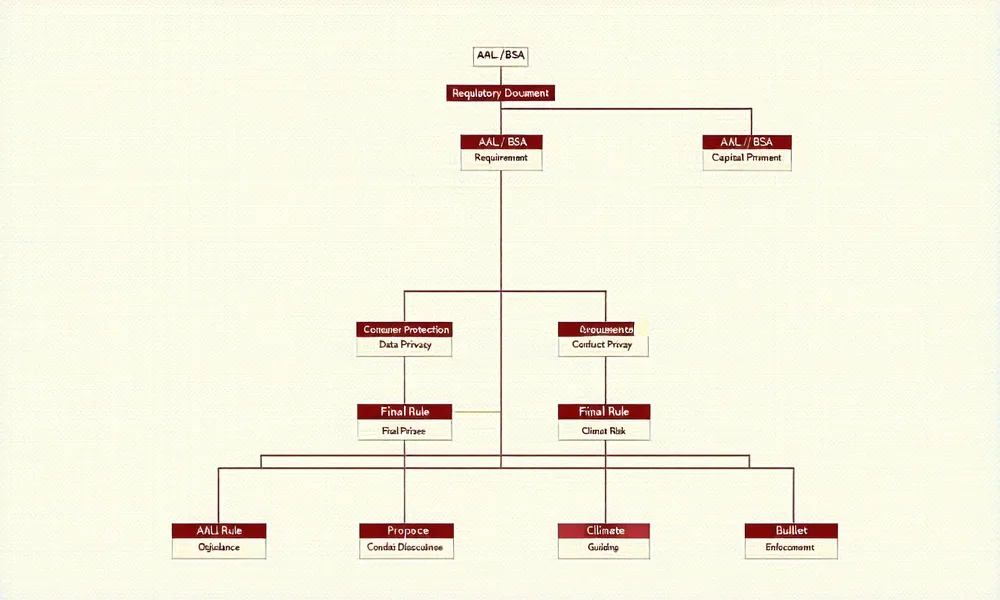
Documents are tagged by which business lines bear the primary compliance obligation. This enables routing within a compliance team and prevents every alert from landing in the CCO's inbox:
Human Review Layer
Ruleward's classification pipeline is designed with AI-assistance at scale and human specialist review for quality assurance. This is not a marketing claim — it is a structural commitment that defines our operating model.
How the review works: AI classification outputs for each ingested document are reviewed by regulatory specialists before delivery to customers. Reviewers have backgrounds in federal financial regulatory practice — not general compliance. Review is focused on:
- Obligation type accuracy (the most consequential classification dimension)
- Business line routing accuracy
- Topic category edge cases where AI confidence is flagged below threshold
Escalation criteria: Documents meeting any of the following criteria are escalated to senior review before delivery: cross-agency joint guidance, enforcement actions from systemically important institutions, documents with novel regulatory theory, and documents where AI confidence score falls below internal threshold.
Error rate approach: We track classification error rate by obligation type on a rolling 30-day basis. Our current target is fewer than 2 obligation-type misclassifications per 1,000 documents processed. Errors identified post-delivery are corrected and customers are notified of the correction.
Publication Latency Standards
Publication latency is the elapsed time between an agency publishing a document and that document appearing in the Ruleward feed, classified and routed. Our standards by source:
| Source | Target Latency | Notes |
|---|---|---|
| Federal Register publications | < 8 hours from publication | Published at 8 AM ET daily; Ruleward captures same morning |
| OCC Bulletins | < 12 hours | Typically published Monday–Friday business hours |
| FDIC FIL | < 12 hours | — |
| Federal Reserve SR Letters | < 12 hours | — |
| CFPB | < 8 hours | High-volume source; priority monitoring |
| NYDFS Circulars | < 24 hours | Daily ingestion cycle |
| FinCEN Advisories | < 24 hours | Daily ingestion cycle |
Latency commitments are contractual for enterprise customers. We report latency metrics on a monthly basis. Contact [email protected] for SLA documentation.
Questions about methodology? Talk to Wilson.
Schedule a briefing to discuss how our classification approach fits your compliance program's specific requirements.
Schedule a Briefing